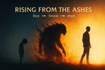

Today, as I sat staring at a blank screen, trying to decide what to write for my blog, a realization hit me with a kind of quiet force: For many people, my words are stories. For me, they are scars.
Some readers approach my books with curiosity, maybe even morbid fascination, a window into a life they have never lived. But for me, every sentence is a memory. Every chapter is a wound. Every page is something I survived.
What does it really mean to live with a traumatic brain injury, PTSD, anxiety, and depression? For most, these are clinical terms, labels, diagnoses, abstract concepts. For me, they have been the axis upon which my entire life has turned.
Since childhood, since the trauma that carved itself into my bones, I have lived as if behind glass. Watching life happen on the other side of a window. Watching people laugh, connect, feel, love, while I stood outside in the cold, in the rain, in the dark. I could see life, but I could not touch it. I could not feel it. Not the way others do.
Inside, there was only a sea of grief and confusion. A storm I could not name. A silence I could not break.
And because I could not feel the way I was supposed to, I lashed out in the only ways I knew how. I reached for maladaptive coping mechanisms, anything to feel something, anything to drown out the emptiness or the ache. I hurt myself. I hurt others. I destroyed things I loved because I did not know how to hold them gently. I did not know how to hold myself gently.
For decades, I thought this was a moral failing. A character flaw. A weakness. But it was not. It was injury. It was survival. It was a brain doing the best it could with what had been done to it.
And now, after all these years, I stand at the edge of something new.
Next week, I begin a medical treatment called Transcranial Magnetic Stimulation (TMS) — a procedure my doctors believe may help awaken the parts of my brain that have been dormant, damaged, or shut down since childhood. They tell me it may help restore emotional processing, reduce the fog of depression, and reconnect pathways that trauma severed long ago.
For the first time in a long time, I feel something unfamiliar. Hope.
Hope that maybe I will not always feel like a ghost in my own life. Hope that maybe I will not always be watching from behind the glass. Hope that maybe I will finally be able to feel the warmth of the world instead of just observing it.
I hope to love my wife with a heart that is fully awake. I hope to feel joy with my children, not just the idea of joy. I hope to experience connection, presence, and the simple beauty of being alive. I hope to live a life that is not defined by trauma, but by what comes after it.
I hope — and that alone feels like a miracle.
This journey has been long, brutal, and lonely. But if TMS can help unlock even a small part of what has been frozen inside me for decades, then maybe — just maybe — the window will finally open.
And I will step through it.

Add comment
Comments